
The House and the Family

"In Genoa, beauty is on the inside. You have to open the door to find it.” — Emanuela Brignone Cattaneo That sentence explains this city, and it explains this house. From Via del Campo you would not guess what stands behind the door: a Rolli palace of 1624, built by the Durazzo family to receive the dignitaries of the Republic, looking out over the old port. Over four centuries the building has been many things — a university, a set of offices. In 2023 it returned to what it was built for: the receiving of guests.

frescoed suite at Palazzo Durazzo Suites, Genoa

The restoration

The seven-year restoration was directed by the architect Emanuela Brignone Cattaneo, with a single principle: historical rigour, open to the contemporary. The decorated façade and the frescoed rooms were protected exactly as they were found. Alongside them sit works by Sam Falls, Nam June Paik and Tomás Saraceno. It was conceived as a declaration of rebirth for Genoa — a place where heritage and genuine luxury meet, and where the identity of the city is the point rather than the backdrop.

The Twelve Suites

No two are alike. Each was designed around a theme drawn from the history of the house or from the idea of travel.

Il Doge

The ceiling is original, frescoed by Domenico Parodi in the 1730s for Stefano Durazzo, nephew of the founder Cesare. It shows Neptune calming the winds: the god of the sea in a commanding pose, subduing the winds he had chained — all but Zephyr, the kind one. It is a portrait of mastery over the sea, and of Stefano Durazzo himself, magistrate of the galleys and later doge. The composition places you on the seabed, looking up into a mythological world. Real shells and gorgonians are set into the walls to complete the illusion.
Read more

Quattro Fiumi

The suite is given to the four principal rivers of Liguria, each drawn as allegory: the Bisagno as a cabbage, for the vegetables of its valley; the Polcevera as bunches of grapes, for the wines of Coronata; the Magra and the Vara marking the borders of the region. At the centre, Neptune with his wife Amphitrite — the cycle of water, and again the maritime dominion of Doge Stefano Durazzo.
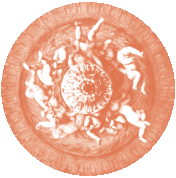
  • Bisagno is symbolized by a cabbage (a reference to the valley's vegetables)
  • Polcevera made from grape clusters (in reference to Coronata)
  • The Magra and Vara Rivers mark the regional boundaries
  • In the center is a fresco of Neptune with his wife Amphitrite, symbolizing the life cycle of water and the maritime dominance of Doge Stefano Durazzo

Le Quattro Stagioni

A room about continual change, and about stillness. Its particular quality is the private chapel beside it, reached directly from the bedroom: a celadon-green ceiling that produces something contemplative rather than devotional. The suite is furnished with restraint — a king-size bed, a pagoda canopy in Ikat cloth — and the palette, the fabrics and the view into the chapel make a suspended, quiet place. It reads as a pause in the sequence of the house.

L'Oriente

Conceived as a stop on the route to eighteenth-century China, in antique papiers peints that cover the walls with the chinoiserie the century loved. On the ceiling, tritons carved by Domenico Parodi recall Stefano Durazzo as protector of the galleys, and with him the family’s long vocation at sea. Baroque and the exotic hold a conversation here — the marine theme that runs through the whole palace, meeting the imagined East.

Le Conchiglie

Drawn from the sea caves of the Ligurian coast. Shells of every form and colour cover the ceiling and the walls, and the windows frame the line of the horizon, so that the sea is present in the detail and in the light at once. Beside the bedroom is a grotto — a small sitting room lined entirely in shells, and the most tactile room in the house.

La Cupola

A play of concave and convex: a vaulted ceiling and walls that turn in a helix, after the spiral of a shell. White, and lit coldly, for the northern seas.

La Musica

A room tuned between past and present. Outside the window, the life of Via del Campo; inside, a work by Nam June Paik across one wall. The original keystone remains, and a trefoil window looks down into the old alleys.

Le Ceramiche

An homage to Persian ceramics, and not only Persian. The headboard takes its pattern from eastern textiles; the shelves hold vessels gathered from several traditions.

I Costumi

In a case in this room hangs a nineteenth-century ceremonial costume — not any costume. It was a gift from Elena of Savoy, Queen of Italy and Princess of Montenegro, to her Genoese lady-in-waiting, Matilde Giustiniani Durazzo. Elena (1873–1952) chose to honour Matilde, in thanks for service at court or in friendship. The dress carries the orientalising refinement of its moment, and something less easily displayed: the closeness between a royal house and this family.

Via del Campo

Looking straight down onto Via del Campo, lively and multi-ethnic, the room puts you in the heart of the caruggio — among its shops, its narrow turnings and its smells. Nobility and ordinary life, side by side, which is precisely what the historic centre of Genoa is.

De Andrè

A tribute to Genoa’s great songwriter and to the song he wrote about this street. The room holds the bohemian city: its famous shops, its departures, and the particular atmosphere of Via del Campo itself.

Il Viaggiatore

The journey here crosses the Mediterranean and continues south. On the walls hangs a collection of rare African exchange currency: ceremonial and parade weapons that were also money — objects of prestige and power in societies where a thing’s worth and its usefulness had not yet been separated. The value was in the metal, and in what the metal could do. They stand at the beginning of the history of money. What follows runs through changing forms and materials until it arrives, several centuries later, at the commercial system of the Republic of Genoa — a city that learned to make value abstract, where a merchant could carry a fortune in a letter and a bank could outlive the men who founded it. The smallest suite in the house holds the largest idea in it.

The Durazzo, and the House

The family came originally from Durrës, on the Albanian coast, and settled in Genoa in the late fourteenth century. They rose quickly: among the principal patrician families of the Republic, with nine doges elected between 1573 and 1805. In 1622 they acquired the Castello di Gabiano, and with it the title of Marquesses of Gabiano. The estate stayed in the line until, in the twentieth century, it passed to the Cattaneo Adorno. Today the Marquess Giacomo Cattaneo Adorno is a direct descendant of both houses, and holds Gabiano — run with his wife Emanuela and their children — as well as this palace.

The palace itself was built in 1624 by Cesare Durazzo to lodge foreign dignitaries, and entered the system of the Palazzi dei Rolli. It remained with the Durazzo into the nineteenth century, passed through several hands, and returned through the crossed inheritances of the Cattaneo and the Adorno to the family that holds it now. Since 2023 it has been a twelve-suite hotel: restored by Emanuela Brignone Cattaneo, with artistic direction shared between Giacomo Cattaneo Adorno and Cesare Barro. A bridge between four centuries of history and a quieter idea of luxury — and, for the family, a way of keeping faith with where they came from.

Contacts